
FAUST (1926, 1 hr 46 min)
F. W. Murnau, Director; Cinematography, Carl Hoffmann, Cinematography; Karl Freund, Camera; Sets and costume design, Robert Herlth and Walter Röhrig, Werner Richard Heymann, original composer. This was Murnau’s last film before he emigrated to California, where he made another four films, including Sunrise, before his death in 1931 in a car crash.
Full orchestra score composed by Jean Hasse (2025)
Premieres on 14 and 20 March, 2026. A new orchestration of Jean’s score for Faust was performed by conductor Marcelo Falcão and the Theatro São Pedro Orchestra in São Paulo, Brazil, on the 100th anniversary year of the film’s screening. Instrumentation: 2-2-2-2, 2-2-3-0, Electric Keyboard, Percussion, Harp, Strings.
- From the conductor, Marcelo Falcão: “The (Saturday) premiere was really great! The audience really engaged and it was a wonderful experience. The diegetic music ideas work really well!” … and “we had an outstanding performance on Friday!” (March 2026)
Chamber orchestra score (2007)
Premiered by the South West Ensemble (CoMA South West and Bristol-based players - 23 musicians)
John Traill, Conductor
13 October 2007 - Victoria Rooms, Queens Road, Clifton, Bristol
21 October - Barbican Centre, Cinema 1, London (Silent Film and Live Music Series)
The screenings featured the domestic German print of the FAUST film, from the Masters of Cinema Series/Eureka DVD.
Bristol Silents have programmed Silent Film events in the South West and across the UK since 2000, including the Slapstick Silent Comedy Festival. The FAUST project was funded in part by: Arts Council England and The Britten-Pears Foundation.
A DVD of FAUST with the premiere recording is available from VM for non-broadcast purposes.
The original chamber orchestra instrumentation was: Fl-Cl-A.Sax-Bsn, Tpt-Tbn, Gtr, Pno, Keybd, Perc, Strings.
The full orchestra instrumentation is: 2-2-2-2, 2-2-3-0, Keybd, Perc, Harp, Strings.
Selected comments received (email and letters, 2007-08) from colleagues and friends
on Jean Hasse’s Faust score (live performances and DVD):
I watched the Faust film the other night and enjoyed it enormously. It's a great film, of course, but your score enhanced the pleasure considerably. The sheer invention amazed me, even accounting for repeated leitmotifs. I also admired the interweaving of diagetic and non-diagetic modes -- I loved the mock-medieval chants and dances. Thank you so much for bringing it to my attention.
- Barry Millington (Writer, music critic, Wagner scholar)
Thank you for writing such a wonderful score and creating such an exciting event. As we discussed after the performance, I know that the sheer time and perseverance involved in composing the score was immense. Thank you for all your dedication to the project, and sheer work - on the administration of the event as well as the score itself. I know that you were anxious about the players, but I thought that they were superb. It was a wonderful afternoon, a real triumph, and we were delighted to be able to present it here at the Barbican.
- Robert Rider (Head of Cinema, Barbican, 2007)
As it is one of the standard texts every grammar school pupil of my generation in Germany, I have read and seen "Faust" as a story, play, and an opera on film and stage on so many occasions that I had gotten rather bored with it. Watching your recording with your music on it has given me a fresh look FAUST! And I thoroughly enjoyed the experience. Not only have you captured the mood and spirit of the overall narrative, but have brought to life and highlighted minute details that were totally lost in performances (all of them accompanied on a piano) I have experienced before.
Your score does not accompany the film but interprets and brings it to life. At no point did I have the feeling that you were filling in, every note is necessary and supports what's up on the screen. Most importantly, your music becomes one with the visuals. You never attempt to push your personal musical beliefs, tastes, in short: personality, into the foreground. It's a superb achievement! Congratulations! I hope the DVD will lead to further live performances.
- Dr Horst Claus (German film specialist, writer, lecturer)
Your DVD is simply marvellous and I’m overjoyed to have a copy. The music is so very clever! Not to mention that I’m in love with the film.
- David Drew (Former music publisher, London)
I just watched Faust and heard your music. Brilliant, beautiful and simply wonderful. What a powerful creation.
- John Knight (Retired professor, Oberlin College Conservatory)
I think it is the best score for a silent film I have heard. The whole score is rare in that it’s a proper accompaniment to a movie and really enhances it. The music is integrated totally. And there are places in the score where it’s full of tension, threat and anxiety.
- Don Fairservice (Film editor and writer)
I LOVED it. All the little touches such as the stones and the singing really made it extra special. Congratulations on a brilliant score.
- Ben Eshmade (Writer and music critic)
……………………………………………………………………
FAUST review from the EPIGRAM, Bristol University's Independent Student Newspaper / 22 October 2007
SIlent movie, shrilling music
Film is not something you expect to be covered in a music section, a silent film less so. But FW Murnau's masterpiece, Faust, with a live score, warranted inclusion. The music was performed by University of Bristol students and other local amateur players who, as a collective, are known as COMA (Contemporary Music-Making for Amateurs). The score used in the screening in the Victoria Rooms on 13 October was composed by Jean Hasse, who is working at the University of Bristol as a teacher of composition. Hasse's score replaced the original score, composed by Werner Richard Heymann, that accompanied the official premier of Faust back in 1926.
I was aware as I sat in the great auditorium of the Victoria Rooms that I was out of my depth. I know very little about classical music and my knowledge of silent films is equally poor. Even in my ignorance, as the lights darkened and we sat in still, silent anticipation, I felt the gravitas of the event. I could feel a creeping fear seeping in, the sort you get when walking into a dark alley or into the woods at night: a sense of danger, which can only be explained by the surrounding silence and darkness.
The music cleverly fits and imitates the film. Hasse has created a score that can replace dialogue and sound effects. The orchestra beautifully recreate the sound of wind, of potions, of village merriment, and chaotic panic. I don't feel that I am watching a silent film. It is the most intense cinematic experience I have ever had.
I am not sure the music needs the film. It is powerful on its own. However, the film needs the music, and the music really needs the conductor. John Traill had his work cut out for him. The timing had to be perfect. The layering of sounds, the chord progressions, the timing, the sudden changes (as when the devil appears and the music bursts), all add to the pressure and difficulty of such an undertaking. And on the whole, it was a brilliant performance: powerful, frightening and intense, and until now I have never really understood the power of music.
- Selina Cuff
The cast of FAUST on set in Germany. Murnau is wearing a hat, Emil Jannings (the ‘devil’) is in front right. Click to enlarge.
Faust, Part 1, music by Jean Hasse, 2025 full orchestra version, played via digitised software instruments.
Note: These links are intended for personal publicity, commentary and critique on my original music in a Fair Use capacity. Performance rights are handled in many countries by the Friedrich Wilhelm Murnau Foundation.
Faust, Part 2, music by Jean Hasse
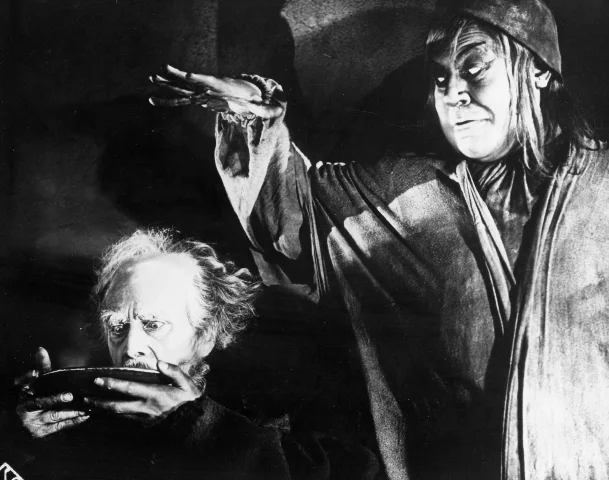
A ‘young’ Devil about to create a ‘young’ Faust.
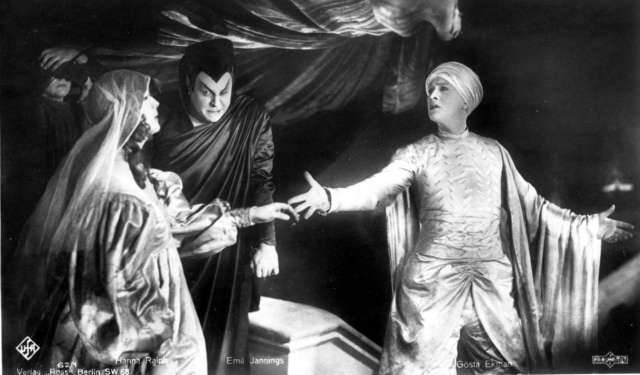
Young Faust seduces the Duchess of Parma, at her wedding.
Faust: “Premiere of the fortnight” in Classical Music magazine, Sept 2007. Click to enlarge.